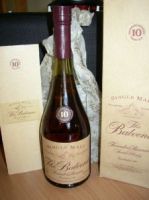
|
Collecting
Whisky
| |
Oh my goodness,
is it really over 10 years since I last updated this page?
I see
that my graphs below show typical prices up to around 2010 and I
even talk about some of these truly great bottles still being
available. Sadly if you do manage to find any of these today
you'll see just what happened during those last 10 years. As it
happens all the photos used on this page are of bottles that
used to be in my own collection, but not any more. Yes I sold
them, yes I made good money from them when I needed it, but if I
still had them today ...........
So why
am I suddenly adding an update to this page after all these
years?
Well,
we're all getting a little older and perhaps starting to look
towards some day in the future when we may need a little extra
money. The banks offer very little by the way of interest so
could it be worth looking towards other possible forms of
investment? Since my article below there has been an explosion
in the number of specialist whisky auction websites which in
turn has created unbelievable interest in older bottlings
sometimes selling at prices never considered just 10 years ago.
But is
my advice below still valid?
If you
look at the basic principles behind my thoughts in the "What to
Collect" section below then yes, my advice is still quite valid,
but I stress that you can't just buy any whisky and expect to
become rich. You need some understanding of individual bottlings
and distilleries.
This
page still generates more questions from my visitors than any
other on the site. I'm often asked for recommendations of what
to 'collect' and also for my opinion on values of different
bottles. Sadly I admit I'm a little out of touch with current
values but as I mentioned there's now a proliferation of whisky
auction sites which offer sales history so you can easily check
values online.
As for
current recommendations
I'm
currently starting to build a new (smaller) collection and
thanks to my job I have access to some usually well-stocked
Travel Retail / Duty Free shops so I'm tending to stick with
bottlings for that marketplace as they tend to be mostly limited
editions specifically for that environment. |
|
| |
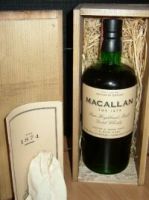
So long as you
picked the right bottlings, Macallan was always a good
distillery to consider in my opinion.
I'm
following my advice again at the moment with a few bottles that
I hope will prove me right, but as I've mentioned elsewhere; if
not then I can always enjoy drinking them, thinking of what
could have been. |
|
| |
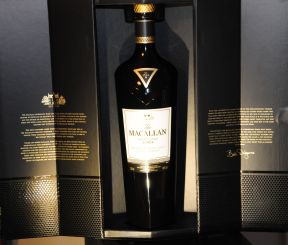
Macallan
Rare Cask Black
I've
selected this one on a bit of a whim as it's a quite different
Macallan. It's a peated expression which to me is not exactly a
typical Macallan expression or style. |
|
 |
|
| |
 |
|
Macallan
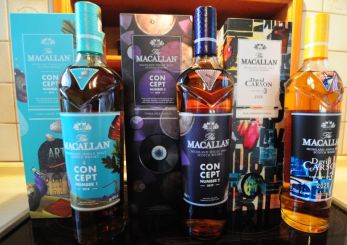
'Concept' Trilogy
Three
years ago in 2018 Macallan launched the first bottling of their
'concept' trilogy. Concept No.1 was a celebration of surreal art
and had an original price of around €130. Now, after just three
years it regularly commands (and sells for) prices around €550
to €585.
In 2019
Concept No.2 was launched as a celebration of whisky & music.
This is a bottling of sherry seasoned Americal Oak Casks and
again had an original price of around €130. I don't see too many
of these on offer but when they are offered they generally sell
for around double the original price. |
|
| |
The 2020
bottling of Edition 3 was delayed due to covid lockdowns and
airports closing their shops so it appeared this year (2021) and
is a cooperation with US graphic designer David Carson. Once
again it's mostly sherry seasoned American Oak Casks but also
has some European, refill and virgin oak casks. Stocks are now
depleting but if you're lucky you may find some for the original
price of €134. If you check online they're already selling for
€190 to €220. |
|
| |
A bit of
a curve ball with a very interesting story
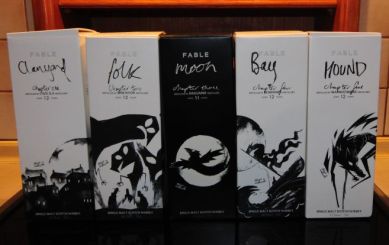
I very
recently came across a new series of whisky from what looks to
be a new Independent Bottler called Fable. Now you'll probably
remember that my recommendation is usually for OB rather than IB
but I just couldn't resist these even though the series appears
to be a little complicated and difficult to find in entirety.
This is a series of Fables from Scotland and currently
has six Chapters, although Chapter 6 seems to be only available
in the USA. Each chapter has a number of bottles, for example
chapter 1 appears to have 4 and each one has a different word
which together complete the title of the fable. As I said
"complicated" but certaily interesting. I believe that 12 Fables
are currently planned but No.s 7 to 12 are still to be confirmed
regarding their target market(s).
Anyway,
I picked up the ones I've currently found which I believe are
bottlings for the German (and UK & EU) market.
|
|
| |
In this
section of Whisky Emporium I will try to answer the
three questions which I am most often asked and
which are usually followed by a healthy
debate about the merits of collecting as opposed to
drinking whisky. Firstly, I
must define what is a collection in this respect?
Well, my idea of a collection is something
purchased with a view to being an
investment for the future and not just a number of bottles being stored until the time
comes to drink them. To me, this is more an inventory than a collection,
even though the bottles may be very valuable.
So, now
on to those three very important questions: |
|
| |
 |
|
1. Why
Collect? |
|
 |
|
| |
Many of us are, by nature,
collectors. We love to acquire, hoard and strive for that ultimate set or
collection. It is similar with whisky, some people collect as many bottlings
as possible from only one distillery, or specific series of bottlings (Macallan
18y classics, Flora & Fauna series & Rare Malts series are just three
examples of many), or people may decide to collect bottlings from only
closed distilleries. Usually, without monetary value in mind, people specialise in bottlings from only their favourite distillery. The list of
possibilities is endless and I am never too surprised when I come across a
new whisky collector specialising in something different, but they are all
collections and, if you are lucky, ones which may even prove to be a good
future investment as their values increase over the years.
So, is it possible to
ensure that your collection increases in value? Of course there are no fixed
guarantees, but if you are careful with your choices, then there is a pretty
good chance that you can tailor your collection to maximise its potential,
but beware; whisky should never be considered a short term investment
as the best, or indeed any positive
results are usually achieved when taking a long term
view of 8-10 years, or even more! |
|
| |
Collectable or Drinkable?
Of
course, all whiskies are drinkable and many people choose never to
collect whisky other than as their drinking supply, awaiting the day it
will be opened and savoured. But, for those looking to collect whisky
with one eye on potential future investment value, what exactly does one
look for?
I believe that collectible
whiskies can be defined or categorised as "limited special editions",
"closed distilleries" & "older, superceded
presentations"
Let's examine these three
options: |
|
| |
1. Limited, special editions
Many
distilleries occasionally produce limited editions, anniversary or
annual bottlings and commemorative bottlings for special events. These
are often
highly collectible as they are by nature, limited in their production.
But how do we
know they are limited? What do we look for?
Some
typical examples shown on this page:
|
|

 |
|
| |
 |
|
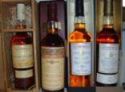
-
The
Macallan 18 year old series – no longer produced as dated bottlings!
-
Hazelburn Edition 1 – Three different labels, only 1700 of each
produced!
-
Glenmorangie Single Cask, dated and numbered wood finishes.
-
Macallan Private Eye
-
Horae
Solaris and the extremely rare
-
Solar
Eclipse with only 16 individually numbered bottles world-wide!
|
|
| |
A word of caution!
Some distilleries enjoy periods of being 'in vogue' where it may seem that
no matter what editions they bottle, people want to buy them just because it
is from that distillery. This does not necessarily ensure that the
distillery will remain so popular with the public in future years, however,
when distilleries are in 'in vogue', rare and limited bottlings can command
higher prices, so choose your times to buy and sell carefully.
I am not
saying that the editions highlighted in these pages are the only ones to buy,
or even certainties, but they are guidelines and examples to show you what
typical attributes to look for. |
|
| |
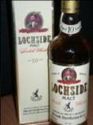
2. Closed distilleries
Many once
thriving Scottish distilleries have in recent years been closed.
Some,
totally demolished and the sites redeveloped. However, as the whisky
takes many years to mature in oak casks, their products may still be
available at the moment, but in some cases, not for too much longer
and, as
these brands may never be produced again, they are
potentially
collectible today and many promise great potential for future
investment.
|
|
 |
|
| |
 |
|
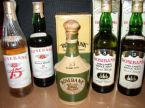
Typical
examples which can still be found
and
which should be
considered for your collections
whilst they are
still available, include:
-
Rosebank (A selection of
which are shown here)
-
Dallas Dhu
-
Port Ellen (The 'Annual
Releases' hold good future potential).
-
Glen Mhor
-
Glenglassaugh (Pre-reopening)
-
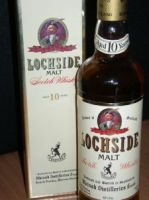
Convalmore, Brora,
Lochside, Pittyvaich, St. Magdalene .... plus many more
|
|
| |
3. Older, superceded
presentations and discontinued bottlings
Over time, distilleries choose to re-market and re-label their products.
Although not originally considered ‘collectable’,
these once standard bottlings may become
more collectable as they are discontinued or even replaced by new bottles,
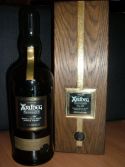
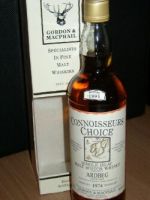
labels and packaging. Some good examples are the old Ardbeg 10 years (Black
Label), the now discontinued Ardbeg 17, 1975 & 1977 and
an old Dufftown Glenlivet from the 1980’s
Within the last 1-2 years
many distilleries have changed, or modernised, their presentations and I am
sure that some may be good potential investments for the longer term
future. These distilleries include; Ardbeg, Auchentoshan, Balblair, Benriach,
Bowmore, Dalmore, Glenmorangie, Highland Park & Macallan |
|

 |
|
| |
Anoher word of caution!
It is in this area of changed presentations and discontinued bottlings where
the popularity, or the fact that a particular distillery is enjoying a
period of being 'in vogue' that values are possibly affected the most. For
example, at the time of writing Ardbeg is enjoying massive popularity and
Rosebank are always being 'tipped' for future potential but haven't really
been promoted to the top league as yet, whereas some bottlings like the (pictured)
Dufftown Glenlivet are now rare and great whiskies, but not so sought after!
At the end of the
day, it will always be a gamble when it comes to investment, but one which
is thoroughly enjoyable and, if all else fails, there is no need to discard
your collection, you always have the fall-back option of drinking it! |
|
| |
I have
experience of malt whisky since the mid-1990's and have acquired extensive knowledge regarding values of many individual bottlings. If you are a
collector of Scottish Malt Whisky, or if you have come across what you
believe may be a rare bottle hidden in your attic, maybe I can offer my experience to
help you.
Just send me an e-mail with full details of your bottle, preferably
including a picture and if I can help, I will do. This service is free of
charge.
|
|
| |
All collections should be insured. What's yours worth?
|
|
| |
Some
individual case studies of particularly interesting editions |
|
| |
 |
Study
1:
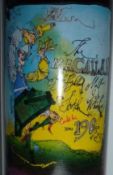
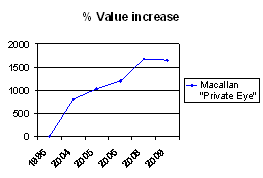
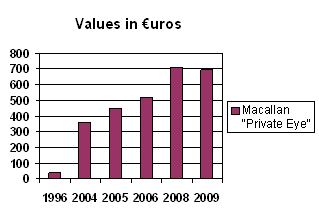
Macallan “Private Eye”
To celebrate the 35th Anniversary of “Private Eye” magazine in
1996, Macallan released a limited edition, special bottling
featuring an enamelled label designed by the famous Private Eye
cartoonist Ralph Steadman.
Including Cask No. 1580, Bonded in 1961 and limited to 5000
individually numbered bottles, this commemorative Macallan
continues to impress at auction and increase or hold value.
|
 |
|
| |
 |
|
Original price in 1996 €40
Price quoted by Macallan, Oct. 2004 €360
Price achieved in auction, Dec. 2005 €450
Price quoted by Macallan, Feb. 2006 €520
Price achieved in auction, Mar. 2008 €710
Price achieved in auction, Apr. 2009 €695
|
|
| |
 |
|
Study 2
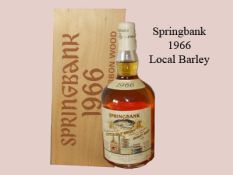
Springbank 1966
‘Local Barley’
|
|
 |
|
| |
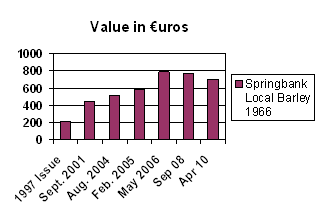
Officially established in 1828 in
Campbeltown on the Mull of Kintyre, Sprinbank remains a family
run distillery which adheres to traditional methods of
distilling. The Springbank 1966 ‘Local Barley’ is a highly
acclaimed distillation made from locally grown barley. Various
casks were filled with this spirit and released as single cask
bottlings between 1997 and 1999. Some of the cask numbers
include 473, 477, 488, 499 & 502. These casks have alcoholic
strengths between 52.1% vol. and 55.1% vol.
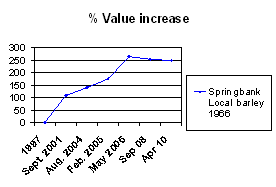
Highly collectible and superb
examples of Springbank whisky, these 1966 Local Barley bottlings
have proven to be excellent investments and should continue to
do so. |
|
| |
 |
|
Original issue price (cask
502, 53% vol.) 1997
€215
Price achieved in auction,
Sept. 2001 €450
Price achieved in auction,
Aug. 2004 €516
Price achieved in auction,
Feb. 2005 €590
Quoted online dealer price,
May 2006 €785
Price achieved in auction,
Sept. 2008 €790
Price achieved in auction,
Apr. 2010 €695
|
|
©
Copyright 2009-2020 by Keith Wood - Alle ‘Rechte vorbehalten -
Whisky-Emporium |
 |